Understanding Milling Machines: An Educational Overview with Manufacturing Insights
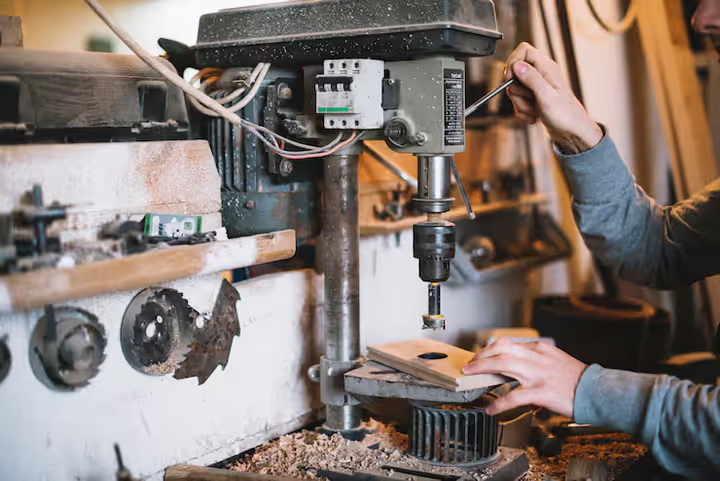
Milling machines are manufacturing tools used to remove material from a workpiece using rotating cutting tools. They exist to shape solid materials into precise forms, dimensions, and surface finishes required for mechanical components and industrial products. Milling is a subtractive machining process that allows controlled material removal from metals, plastics, composites, and other solid materials.
The development of milling machines dates back to early industrial manufacturing, where manual shaping methods lacked accuracy and repeatability. As engineering demands increased, milling machines were introduced to produce flat surfaces, slots, gears, contours, and complex geometries with greater precision. Over time, mechanical milling machines evolved into electrically powered and later computer-controlled systems.
Today, milling machines are essential in manufacturing, fabrication, tooling, and prototyping environments, supporting both small-scale workshops and large industrial production facilities.
Importance: Why Milling Machines Matter in Manufacturing
Milling machines play a central role in modern manufacturing because they enable accurate and repeatable production of parts across many industries.
Who relies on milling machines
-
Manufacturing and fabrication plants
-
Tool and die makers
-
Automotive and aerospace industries
-
Equipment and machinery manufacturers
-
Educational and training institutions
-
Maintenance and repair operations
Key challenges milling machines help address
-
Producing precise dimensions and tolerances
-
Machining complex shapes and profiles
-
Maintaining consistency across multiple parts
-
Supporting both small-batch and large-scale production
-
Working with a wide range of materials
By offering controlled cutting and versatility, milling machines support efficiency and quality in manufacturing processes.
Recent Updates and Trends (2024–2025)
Milling machine technology continues to evolve as manufacturing adopts automation, digital control, and advanced materials.
Recent trends
-
CNC integration advancements (2024): Improved motion control enhanced accuracy and repeatability.
-
High-speed milling techniques (2024–2025): Faster spindle speeds improved productivity and surface quality.
-
Multi-axis machining (2024): Increased use of 4-axis and 5-axis milling enabled complex geometries.
-
Tool condition monitoring (2025): Sensors provided better insight into tool wear and performance.
-
Energy-efficient machine designs (2025): Optimized motors and drives reduced power consumption.
These trends highlight the shift toward precision, automation, and efficiency in machining operations.
Laws and Policies Affecting Milling Machine Operations
Milling machine use is governed by industrial safety, equipment standards, and environmental regulations.
Key regulatory considerations
-
Workplace safety standards: Address guarding, emergency stops, and operator protection.
-
Electrical and machinery regulations: Govern installation and operation of powered equipment.
-
Noise and vibration guidelines: Apply to machining environments.
-
Environmental policies: Influence coolant usage and waste disposal.
-
Maintenance and inspection requirements: Ensure safe and reliable operation.
Compliance with these policies supports safe working conditions and responsible manufacturing practices.
Tools and Resources Used with Milling Machines
Effective milling operations rely on appropriate tools, accessories, and technical resources.
Machining and Control Tools
-
Cutting tools and tool holders
-
Spindle speed and feed rate controllers
-
Digital readout systems
-
CNC programming interfaces
-
Workholding devices such as vises and fixtures
Maintenance and Quality Resources
-
Tool inspection and measurement instruments
-
Lubrication and coolant management tools
-
Preventive maintenance schedules
-
Dimensional inspection gauges
-
Operator reference manuals
These tools help ensure machining accuracy, equipment reliability, and consistent output.
Table: Common Types of Milling Machines
| Milling Machine Type | Description |
|---|---|
| Vertical Milling Machine | Spindle oriented vertically |
| Horizontal Milling Machine | Spindle oriented horizontally |
| Universal Milling Machine | Supports both vertical and horizontal operations |
| CNC Milling Machine | Computer-controlled multi-axis machining |
| Bed-Type Milling Machine | Designed for heavy and large workpieces |
| Turret Milling Machine | Adjustable spindle and versatile setup |
Table: Typical Operations Performed Using Milling Machines
| Operation | Description |
|---|---|
| Face Milling | Produces flat surfaces |
| Slot Milling | Cuts grooves and slots |
| End Milling | Machines profiles and contours |
| Drilling and Boring | Creates and refines holes |
| Gear Cutting | Produces gear teeth |
| Pocket Milling | Removes material within defined boundaries |
Milling Machine Workflow Overview
A standard milling machine workflow includes:
-
Workpiece Preparation
Material is selected and secured on the machine table. -
Tool Selection
Appropriate cutting tools are chosen based on material and operation. -
Parameter Setting
Spindle speed, feed rate, and depth of cut are defined. -
Machining Operation
Material is removed through controlled cutting action. -
Inspection
Dimensions and surface quality are checked. -
Completion and Cleaning
Finished parts are removed and the machine is prepared for the next task.
This workflow ensures precise and repeatable machining results.
FAQs
1. What is a milling machine used for?
A milling machine is used to remove material from a workpiece to create specific shapes and dimensions.
2. What materials can be machined using milling machines?
Metals, plastics, composites, and some ceramics can be machined depending on tooling and setup.
3. How does CNC milling differ from manual milling?
CNC milling uses computer control for automated, precise, and repeatable operations.
4. Why is tool selection important in milling?
Proper tools ensure efficient cutting, surface quality, and tool life.
5. Can milling machines perform multiple operations?
Yes. Milling machines can perform drilling, boring, slotting, and contouring operations.
Conclusion
Milling machines are fundamental tools in modern manufacturing, enabling precise shaping and machining of a wide range of materials. From traditional manual machines to advanced CNC systems, milling technology continues to evolve to meet increasing demands for accuracy, efficiency, and complexity. Recent advancements in multi-axis machining, tool monitoring, and energy-efficient design have expanded their capabilities further. Supported by safety regulations, structured workflows, and specialized tools, milling machines remain essential for producing reliable, high-quality components across industrial sectors.