Understanding Jet Mill Machines: An Educational Overview with Micronization Insights
A jet mill machine is a type of grinding system that reduces particle size using high-velocity streams of compressed gas rather than mechanical grinding media. It exists to produce extremely fine powders with controlled particle size distribution while minimizing contamination and heat generation. Jet mill machines are especially effective for materials that are heat-sensitive, abrasive, or require high purity.
Traditional milling methods rely on physical contact between grinding media and material, which can introduce wear, contamination, and excessive heat. As industries such as pharmaceuticals, chemicals, and advanced materials demanded finer and more uniform powders, conventional milling reached its practical limits. Jet mill machines were developed to address these challenges by using particle-to-particle collisions driven by high-speed gas flow.
Today, jet mill machines are widely used in applications requiring precise micronization, narrow particle size control, and clean processing environments.
Importance: Why Jet Mill Machines Matter Today
Jet mill machines are important because many modern manufacturing processes depend on ultra-fine powders with consistent characteristics.
Who relies on jet mill machines
-
Pharmaceutical and healthcare manufacturing facilities
-
Chemical and specialty material producers
-
Pigment and coating material manufacturers
-
Battery and advanced energy material processors
-
Mineral processing and powder metallurgy operations
-
Research and quality control laboratories
Key challenges jet mill machines help address
-
Achieving ultra-fine particle sizes
-
Maintaining narrow particle size distribution
-
Avoiding contamination from grinding media
-
Limiting heat generation during milling
-
Processing abrasive or hard materials
-
Meeting strict purity and quality standards
By eliminating mechanical grinding components, jet mill machines support high-precision powder processing.
Recent Updates and Trends (2024–2025)
Jet mill technology continues to advance as material science and process control requirements evolve.
Recent trends
-
Improved classifier designs (2024): Enhanced control of particle cut size and uniformity.
-
Energy optimization techniques (2024–2025): More efficient use of compressed gas.
-
Integration with digital controls (2024): Improved monitoring and parameter adjustment.
-
Compatibility with advanced materials (2025): Expanded use in battery and high-performance material processing.
-
Compact and modular system layouts (2025): Easier integration into existing production lines.
These trends reflect ongoing efforts to balance precision, efficiency, and operational flexibility.
Laws and Policies Affecting Jet Mill Machine Operation
Jet mill machines operate within industrial safety, environmental, and quality regulations.
Key regulatory considerations
-
Workplace safety standards: Address high-pressure systems and noise exposure.
-
Machinery and electrical regulations: Govern installation and operation of powered equipment.
-
Dust and particulate control guidelines: Reduce airborne material exposure.
-
Environmental regulations: Influence compressed gas usage and emissions.
-
Industry-specific quality standards: Apply to pharmaceutical and chemical applications.
Compliance with these frameworks supports safe, reliable, and responsible milling operations.
Tools and Resources Used with Jet Mill Machines
Effective operation of jet mill machines relies on specialized tools and supporting resources.
Grinding and Control Tools
-
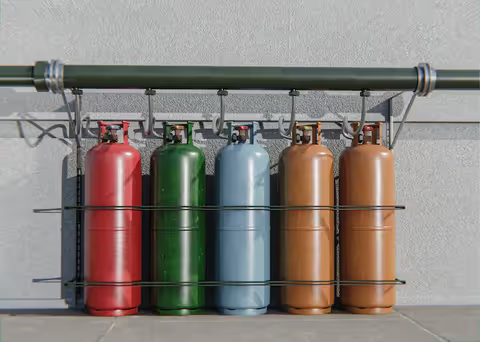
High-pressure gas supply systems
-
Precision nozzles and grinding chambers
-
Integrated particle classifiers
-
Digital control panels and sensors
-
Feed and discharge control mechanisms
Maintenance and Quality Resources
-
Preventive maintenance schedules
-
Particle size analysis instruments
-
Gas pressure monitoring tools
-
Cleaning and inspection procedures
-
Operator training documentation
These resources help maintain consistent performance and product quality.
Table: Core Components of a Jet Mill Machine
| Component | Function |
|---|---|
| Grinding Chamber | Area where particle collisions occur |
| High-Velocity Nozzles | Accelerate gas streams |
| Classifier | Controls final particle size |
| Gas Supply System | Provides compressed air or gas |
| Feed System | Introduces material into the mill |
| Control Unit | Regulates operating parameters |
Table: Typical Applications of Jet Mill Machines
| Industry | Application Purpose |
|---|---|
| Pharmaceuticals | Fine drug particle preparation |
| Chemicals | Micronization of specialty powders |
| Pigments | Uniform color particle sizing |
| Energy Materials | Battery powder processing |
| Minerals | Fine mineral grinding |
| Research | Laboratory-scale micronization |
Jet Mill Machine Operational Workflow Overview
A typical jet mill machine workflow includes:
-
Material Feeding
Raw material is introduced into the grinding chamber. -
Gas Acceleration
Compressed gas accelerates through nozzles. -
Particle Collision
Particles collide with each other at high speed. -
Size Classification
Fine particles exit through the classifier. -
Oversize Recirculation
Larger particles remain for further grinding. -
Product Collection
Finished powder is collected downstream.
This workflow enables precise and repeatable fine grinding.
FAQs
1. What is a jet mill machine used for?
It is used for ultra-fine grinding and micronization of powders.
2. How does a jet mill differ from mechanical mills?
It uses high-velocity gas instead of grinding media.
3. Are jet mill machines suitable for heat-sensitive materials?
Yes. Minimal heat generation makes them suitable for such materials.
4. Can jet mill machines process abrasive materials?
Yes. The absence of mechanical contact reduces wear.
5. Do jet mill machines require precise control?
Yes. Gas pressure and classifier settings are critical for consistency.
Conclusion
Jet mill machines are advanced grinding systems designed to meet the growing demand for ultra-fine, high-purity powders across a wide range of industries. By relying on high-velocity gas streams and particle-to-particle collisions, these machines overcome many limitations of traditional mechanical milling. Recent advancements in classifier design, energy efficiency, and digital control have further improved their performance and flexibility. Supported by regulatory frameworks, structured workflows, and specialized tools, jet mill machines continue to play a vital role in precision powder processing and modern material manufacturing.