TNF Alpha ELISA Kit Guide: Explore Principles, Key Insights, and Essential Information
A TNF Alpha ELISA Kit is a laboratory tool designed to detect and quantify Tumor Necrosis Factor-alpha (TNF-α), a cytokine involved in inflammation and immune regulation. TNF-α is produced by immune cells during infection, tissue injury, and chronic inflammatory responses. Because its levels change significantly in various biological conditions, researchers use ELISA (Enzyme-Linked Immunosorbent Assay) to measure its concentration accurately.
The kit exists to support immunology, cell biology, toxicology, diagnostic research, and therapeutic development. Before ELISA became widely adopted, cytokine quantification relied on complex bioassays that lacked precision. ELISA technology standardized detection methods and improved reproducibility, enabling scientists to study immune pathways with clarity.
Over time, improvements in antibody specificity, assay sensitivity, and microplate technology strengthened TNF-α quantification and expanded its applications in both academic and industrial research environments.
Importance: Why TNF Alpha ELISA Kits Matter Today
TNF-α plays a central role in inflammation, apoptosis, and immune regulation. Tracking its concentration helps researchers understand key biological processes and evaluate responses to experimental treatments.
Who relies on TNF Alpha ELISA kits
-
Immunology researchers studying cytokine pathways
-
Pharmaceutical scientists evaluating therapeutic responses
-
Toxicologists analyzing chemical or environmental triggers
-
Cell culture laboratories measuring secreted cytokines
-
Academic institutions conducting inflammation-related studies
Research problems it helps solve
-
Measuring inflammatory responses in biological samples
-
Monitoring immune activation during experiments
-
Supporting biomarker studies with quantifiable data
-
Comparing cytokine levels across treatment or control groups
-
Assessing the effects of compounds on cellular signalling
Because TNF-α is linked to autoimmune pathways, oxidative stress, pathogen response, and chronic inflammatory conditions, accurate measurement remains critical in both fundamental and applied research.
Recent Updates and Trends
Between 2024 and 2025, several scientific and technological trends influenced the use of TNF Alpha ELISA kits.
Key developments
-
Higher-sensitivity assay formats (2024): New detection antibodies improved signal amplification, allowing measurement of ultralow TNF-α concentrations.
-
Standardization improvements (2024–2025): Many laboratories implemented updated quality-control guidelines to ensure reproducibility, particularly in cross-lab studies.
-
Automation in plate reading (2025): Enhanced microplate readers with AI-assisted interpretation reduced manual data errors.
-
Integration of multiplex systems (2024): Researchers began combining TNF-α detection with other cytokines to study broader inflammatory networks.
-
Increased focus on translational research (2025): Studies incorporated TNF-α measurements into therapeutic evaluation pipelines for immune-modulating compounds.
These updates show that ELISA systems continue to evolve, improving sensitivity, consistency, and workflow efficiency.
Laws and Policies Affecting TNF Alpha ELISA Use
While TNF Alpha ELISA kits themselves are research tools, several regulatory areas influence their production, handling, and use.
Typical policy considerations
-
Laboratory biosafety rules: Regulations require safe handling of biological samples such as serum, plasma, or culture supernatants.
-
Quality assurance guidelines: Many institutions follow GLP (Good Laboratory Practice) frameworks to maintain accurate testing environments.
-
Chemical handling policies: Reagents such as substrates and stop solutions must comply with standard chemical-safety regulations.
-
Data integrity standards: Research institutions maintain documentation practices to ensure accurate reporting and traceability.
-
Ethical sample acquisition: If human or animal samples are used, protocols must follow institutional and national ethical standards.
These policies aim to support safe laboratory environments and ensure that TNF-α data is generated with scientific accuracy and transparency.
Tools and Resources Related to TNF Alpha ELISA Kits
Several digital tools, laboratory resources, and analytical aids help researchers interpret TNF-α data effectively.
Analytical Tools
-
Standard curve generators
-
Optical-density (OD) calculators
-
Cytokine concentration interpolation software
-
Plate layout templates
-
Statistical analysis tools for replicate variation
Research Resources
-
Cytokine pathway diagrams
-
Immunoassay troubleshooting guides
-
Pipetting calibration charts
-
Plate reader optimization guidelines
-
Protocol comparison sheets for sensitivity and specificity
These tools support accuracy, reproducibility, and efficient workflow.
Table: Key Components of a TNF Alpha ELISA Kit
| Component | Function |
|---|---|
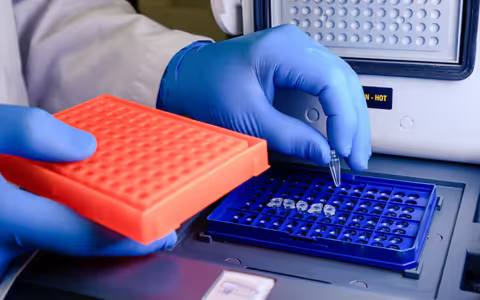
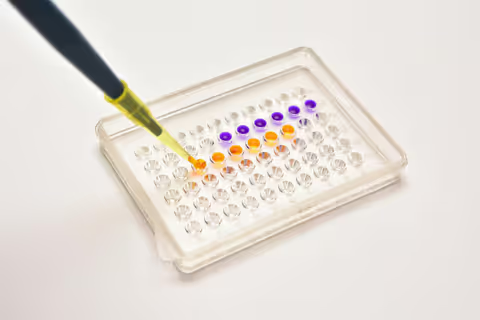
| Pre-coated Microplate | Binds TNF-α using capture antibodies |
| Standards | Generate a known concentration curve |
| Detection Antibody | Binds TNF-α for signal enhancement |
| Enzyme Conjugate | Enables colorimetric reaction |
| Substrate Solution | Produces visible color for quantification |
| Stop Solution | Stabilizes color for measurement |
| Wash Buffer | Removes nonspecific binding |
Table: Common Sample Types and Typical TNF-α Ranges
| Sample Type | Approximate Range (pg/mL) |
|---|---|
| Serum | 1–50+ |
| Plasma | 1–40+ |
| Cell Culture Supernatant | 5–500+ |
| Tissue Homogenate | Highly variable |
Ranges vary widely depending on experimental conditions and biological context.
FAQs
1. What does a TNF Alpha ELISA kit measure?
It measures the concentration of TNF-α, a cytokine involved in inflammation and immune signalling, in biological samples such as serum, plasma, or cell culture media.
2. How does a TNF Alpha ELISA work?
It uses antibody-based detection: TNF-α binds to a capture antibody, followed by a detection system that generates a measurable color proportional to cytokine concentration.
3. Why do researchers measure TNF-α levels?
TNF-α is a key biomarker of inflammation and immune activation. Tracking its levels helps researchers study immune pathways, cellular responses, and experimental treatments.
4. What factors can affect ELISA accuracy?
Common influences include pipetting errors, plate washing inconsistencies, improper storage of reagents, and sample degradation.
5. Can TNF-α levels vary widely between samples?
Yes. TNF-α concentrations depend on biological conditions, sample type, and environmental stimuli, making controlled experimental design essential.
Conclusion
TNF Alpha ELISA kits are fundamental research tools for measuring inflammatory responses and understanding immune dynamics. Their importance continues to grow as science advances toward precision-driven evaluation of cytokine pathways. With improved assay sensitivity, automated plate-reading technologies, and standardized quality guidelines, TNF-α detection has become more reliable and reproducible. Supported by well-established policies, analytical tools, and structured laboratory practices, TNF Alpha ELISA kits remain essential for immunology, toxicology, and biomedical research.
Disclaimer: The information provided in this article is for informational purposes only. We do not make any claims or guarantees regarding the accuracy, reliability, or completeness of the information presented. The content is not intended as professional advice and should not be relied upon as such. Readers are encouraged to conduct their own research and consult with appropriate professionals before making any decisions based on the information provided in this article.