Tissue Paper Machine Guide: Explore Manufacturing Principles, Process Insights, and Essential Information
A tissue paper machine is an industrial papermaking system designed to produce lightweight paper products such as facial tissue, toilet paper, napkins, and paper towels. It exists to manufacture paper with specific characteristics, including softness, absorbency, bulk, and strength, which differ from standard printing or packaging paper.
The development of tissue paper machines evolved from traditional papermaking technology, with modifications to accommodate lower basis weights and higher softness requirements. Early papermaking focused on thicker sheets, but increasing demand for hygienic and disposable paper products led to specialized machines optimized for tissue production.
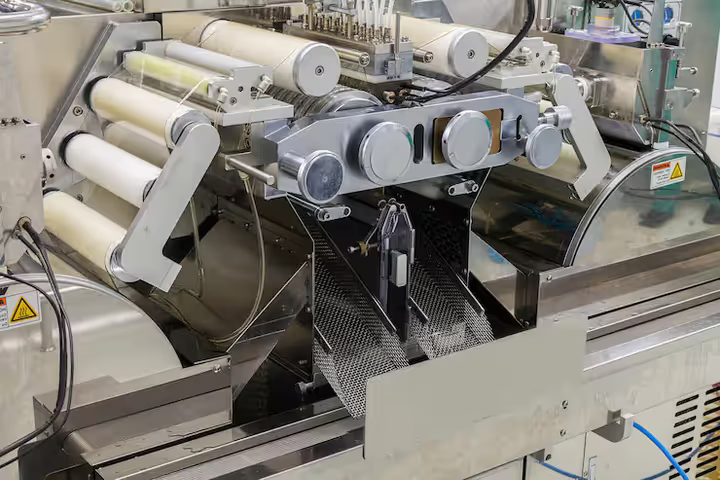
Modern tissue paper machines integrate mechanical, thermal, and control systems to convert pulp slurry into finished tissue reels efficiently and consistently. These machines operate continuously and are designed to maintain precise control over fiber formation, drying, and sheet properties.
Importance: Why Tissue Paper Machines Matter in Manufacturing
Tissue paper machines play a vital role in meeting global demand for hygiene and personal care paper products. Their importance lies in their ability to produce large volumes of uniform, high-quality tissue paper with controlled physical properties.
Who relies on tissue paper machines
-
Paper manufacturing plants
-
Hygiene and personal care product producers
-
Food service and hospitality supply chains
-
Healthcare and institutional facilities
-
Operations and quality control teams
Key challenges tissue paper machines help address
-
Producing lightweight paper with consistent softness
-
Achieving high absorbency without compromising strength
-
Maintaining continuous high-speed production
-
Managing fiber usage efficiently
-
Ensuring uniform sheet formation and drying
-
Supporting product consistency across large batches
These machines enable manufacturers to balance productivity with quality requirements in tissue paper production.
Recent Updates and Trends (2024–2025)
Tissue paper machine technology continues to advance as manufacturers focus on efficiency, sustainability, and product performance.
Recent trends
-
Energy-efficient drying systems (2024): Improved hood designs and heat recovery systems reduced energy consumption.
-
Advanced headbox designs (2024–2025): Enhanced fiber distribution improved sheet uniformity and softness.
-
Digital control and automation (2024): Real-time monitoring improved process stability and reduced variability.
-
Use of alternative fibers (2025): Machines adapted to process recycled and non-wood fibers more effectively.
-
Higher machine speeds (2025): Mechanical upgrades supported increased output while maintaining quality standards.
These developments reflect the industry's focus on operational efficiency and sustainable production practices.
Laws and Policies Affecting Tissue Paper Machine Operations
Tissue paper manufacturing operates under regulations that address safety, environmental impact, and product standards.
Key regulatory considerations
-
Environmental regulations: Control water usage, effluent discharge, and air emissions.
-
Occupational safety rules: Govern machine guarding, noise levels, and operator protection.
-
Product quality standards: Define hygiene and safety requirements for tissue products.
-
Energy efficiency guidelines: Encourage reduced consumption and optimized processes.
-
Waste management policies: Address handling of sludge, trims, and by-products.
Compliance with these policies ensures responsible and safe operation of tissue paper machines.
Tools and Resources Used with Tissue Paper Machines
Operating and maintaining tissue paper machines requires specialized tools and technical resources.
Process and Control Tools
-
Distributed control systems (DCS)
-
Quality monitoring sensors
-
Basis weight and moisture measurement tools
-
Machine speed and tension control systems
-
Process data analysis dashboards
Maintenance and Optimization Resources
-
Preventive maintenance schedules
-
Equipment alignment and calibration tools
-
Roll and fabric inspection guides
-
Lubrication management resources
-
Operator training manuals
These tools support stable operation, quality consistency, and equipment longevity.
Table: Main Sections of a Tissue Paper Machine
| Section | Function |
|---|---|
| Headbox | Distributes pulp slurry evenly onto the forming fabric |
| Forming Section | Removes water and forms the paper web |
| Press Section | Further dewaters the sheet and increases strength |
| Yankee Dryer | Dries the tissue sheet and contributes to softness |
| Hood System | Supplies hot air for efficient drying |
| Reel Section | Winds finished tissue into large parent rolls |
Table: Key Properties Controlled by Tissue Paper Machines
| Property | Description |
|---|---|
| Basis Weight | Weight per unit area of the tissue sheet |
| Softness | Tactile feel of the finished product |
| Absorbency | Ability to take up and retain liquid |
| Tensile Strength | Resistance to tearing or breaking |
| Bulk | Thickness relative to weight |
| Moisture Content | Residual water in the finished tissue |
Tissue Paper Machine Production Workflow Overview
A typical tissue paper machine workflow includes:
-
Pulp Preparation
Fibers are mixed with water to create a uniform slurry. -
Sheet Formation
The slurry is delivered to the forming section to create a wet web. -
Pressing
Mechanical pressure removes additional water and improves fiber bonding. -
Drying
The sheet is dried on the Yankee dryer using heat and airflow. -
Creping
The dried sheet is creped to enhance softness and bulk. -
Reeling
The finished tissue is wound into large rolls for further converting.
This workflow supports continuous, high-speed tissue production.
FAQs
1. What products are made using tissue paper machines?
They produce tissue-based products such as facial tissue, toilet paper, napkins, and paper towels.
2. How does a tissue paper machine differ from other paper machines?
It is designed for lightweight paper with high softness and absorbency rather than thickness or rigidity.
3. What role does the Yankee dryer play?
The Yankee dryer removes most of the remaining moisture and contributes to tissue softness and strength.
4. Can tissue paper machines use recycled fibers?
Yes. Many machines are designed to process recycled pulp with appropriate cleaning and preparation steps.
5. How is product quality monitored during production?
Quality sensors and control systems continuously measure properties such as moisture, basis weight, and strength.
Conclusion
Tissue paper machines are specialized manufacturing systems that enable the efficient production of lightweight, absorbent, and soft paper products essential for daily hygiene and personal care. By integrating precise forming, pressing, drying, and creping technologies, these machines maintain consistent product quality at high production speeds. Recent advancements in energy efficiency, automation, and fiber processing continue to enhance machine performance. Supported by regulatory frameworks and advanced control tools, tissue paper machines remain a cornerstone of modern paper manufacturing and play a critical role in meeting global demand for tissue products.