Explore Motor Winding Machines and Their Role in Modern Electrical Manufacturing
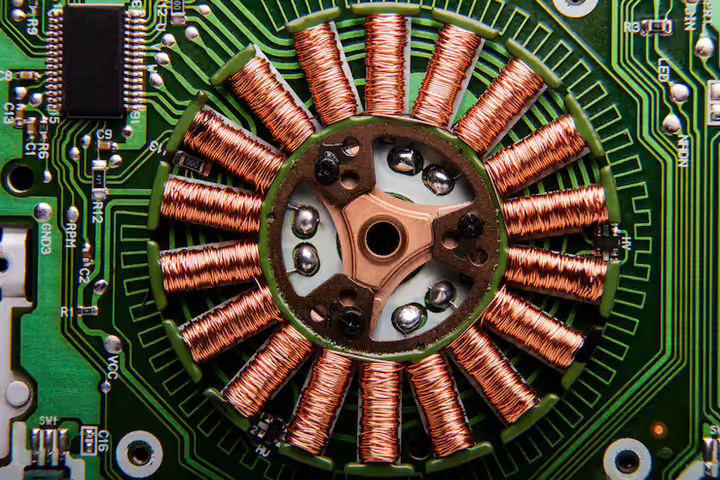
Motor winding machines are specialized industrial systems used to wind copper or aluminum wire around motor cores to create electromagnetic coils. These coils are essential components in electric motors, transformers, generators, and alternators. Without precise winding, electric motors cannot efficiently convert electrical energy into mechanical motion.
The need for motor winding machines emerged as electric motors became more complex and widely used across industries. Manual winding methods were once common, but they lacked consistency and accuracy. As industrial automation advanced, winding machines were developed to improve precision, repeatability, and production stability.
Today, motor winding machines are integral to electric motor manufacturing plants, research facilities, and repair workshops. They support a wide range of motor types, including AC motors, DC motors, servo motors, traction motors, and high-efficiency industrial motors.
Why Motor Winding Machines Matter Today
Motor winding machines play a crucial role in modern industrial and technological ecosystems. Their importance has grown significantly due to increased demand for energy-efficient systems and electrification.
They affect multiple sectors, including:
-
Electric vehicle manufacturing
-
Renewable energy systems
-
Industrial automation
-
HVAC equipment production
-
Consumer electronics
Key problems they help solve include:
-
Inconsistent coil geometry
-
Electrical inefficiency in motors
-
Excessive heat generation
-
Reduced motor lifespan
High-precision winding ensures optimal electromagnetic performance, which directly influences torque output, power efficiency, and thermal stability. With global emphasis on energy conservation, accurate motor winding has become more important than ever.
Recent Updates and Industry Developments
Over the past year, motor winding machine technology has evolved rapidly, driven by automation and digital manufacturing trends.
Key updates since 2025 include:
-
January 2025: Increased adoption of CNC-controlled winding machines for multi-slot stator designs
-
March 2025: Integration of AI-based tension control systems to reduce wire stress
-
June 2025: Growth in hairpin winding technology for electric vehicle motors
-
September 2025: Expansion of Industry 4.0 connectivity using IoT-enabled winding systems
These advancements focus on improving winding accuracy, reducing material waste, and supporting high-speed motor production. Smart sensors and real-time monitoring are now common features in advanced winding equipment.
Regulatory Environment and Policy Influence
Motor winding machines are influenced by industrial safety standards, energy efficiency regulations, and manufacturing quality frameworks.
In many countries, regulations impact how motors are designed and produced, which indirectly affects winding processes.
Common regulatory areas include:
-
Electrical safety compliance (IEC and ISO standards)
-
Energy efficiency norms for electric motors
-
Workplace safety rules for automated machinery
-
Environmental guidelines for copper and insulation materials
Government-led electrification programs and renewable energy initiatives have also increased demand for efficient motor manufacturing technologies. These policies encourage manufacturers to adopt precise and standardized winding methods to meet compliance benchmarks.
Tools, Systems, and Learning Resources
A range of tools and digital resources support understanding and application of motor winding machines.
Commonly used tools and resources include:
-
Motor winding design software
-
Coil pitch and slot calculation tools
-
Wire tension monitoring systems
-
Stator and rotor simulation platforms
-
Industrial automation controllers
Reference platforms often include:
-
Engineering standards documentation portals
-
Electrical engineering learning platforms
-
Motor design research publications
-
Manufacturing process optimization tools
These resources help engineers and technicians understand winding patterns, insulation requirements, and electromagnetic performance factors.
Common Types of Motor Winding Machines
Motor winding machines are classified based on application and automation level.
| Machine Type | Typical Application | Automation Level |
|---|---|---|
| Manual Winding Machines | Small motors and repairs | Low |
| Semi-Automatic Winding Systems | Medium-scale production | Medium |
| Fully Automatic CNC Machines | High-volume motor manufacturing | High |
| Needle Winding Machines | Compact stators | High |
| Flyer Winding Machines | High-speed stator winding | High |
Each type is designed to handle specific motor geometries and production requirements.
Performance Factors Influenced by Winding Quality
High-quality winding directly impacts motor performance metrics.
| Parameter | Effect of Precision Winding |
|---|---|
| Electrical Efficiency | Reduced energy losses |
| Thermal Stability | Lower heat buildup |
| Torque Output | Improved electromagnetic force |
| Noise and Vibration | Reduced mechanical imbalance |
| Motor Lifespan | Extended operational durability |
This explains why manufacturers prioritize advanced winding technologies.
Frequently Asked Questions
What is the primary function of a motor winding machine?
A motor winding machine forms electromagnetic coils by accurately placing conductive wire around motor cores, enabling motor operation.
Which materials are commonly used in motor winding?
Copper is most widely used due to high conductivity, while aluminum is used in some lightweight or cost-sensitive designs.
How does automation improve winding accuracy?
Automation ensures consistent wire tension, precise coil placement, and repeatable winding patterns, reducing human error.
Are motor winding machines used only for new motors?
They are used for both new motor production and motor refurbishment in industrial settings.
Why is insulation important in motor winding?
Insulation prevents electrical short circuits, enhances safety, and improves long-term motor reliability.
Conclusion
Motor winding machines are foundational technologies in electric motor manufacturing and modernization. They exist to ensure precision, efficiency, and reliability in electromagnetic coil production. As industries move toward electrification, automation, and sustainability, the role of accurate motor winding continues to expand.
Recent technological developments have made winding systems smarter, faster, and more adaptable to complex motor designs. Regulatory frameworks and energy efficiency standards further reinforce the need for advanced winding solutions. Supported by digital tools and engineering resources, motor winding machines remain central to the future of industrial automation and electric mobility.