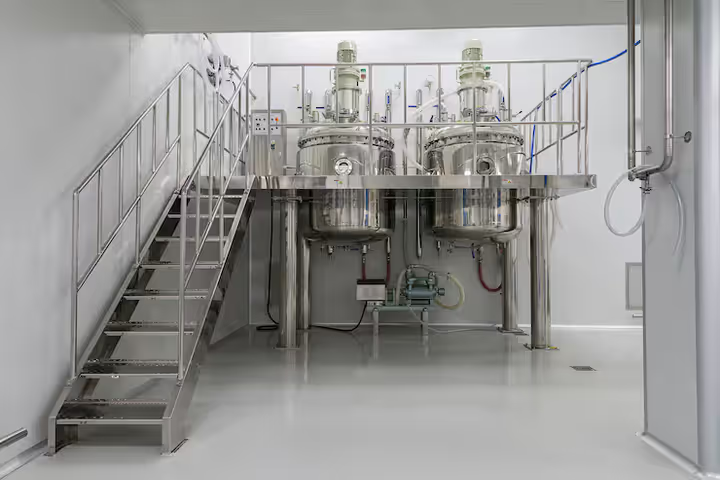
Chemical Reactor Manufacturing Equipment: Process Explanation
Chemical reactor manufacturing equipment refers to industrial systems designed to carry out controlled chemical reactions at scale. These reactors form the core of chemical processing industries, enabling raw materials to be transformed into valuable products such as polymers, pharmaceuticals, fuels, fertilizers, and specialty chemicals.
A chemical reactor is not a single device but a combination of engineered components that manage temperature, pressure, mixing, reaction time, and safety. Manufacturing equipment includes vessels, agitation systems, heat exchangers, control instruments, and safety mechanisms. Each component is engineered to maintain stable reaction conditions while maximizing efficiency and product consistency.
The development of chemical reactor equipment emerged alongside industrial chemistry in the late 19th and early 20th centuries. As demand for mass production increased, laboratory reactions were no longer sufficient. Large-scale reactors became essential to ensure repeatable outcomes, operational safety, and compliance with industrial standards.
Importance
Chemical reactor manufacturing equipment plays a critical role in modern industrial ecosystems. It directly affects productivity, product quality, environmental performance, and workplace safety.
Industries influenced by this equipment include:
-
Chemical processing
-
Pharmaceutical manufacturing
-
Petrochemical and refining operations
-
Energy and hydrogen production
-
Food and specialty materials processing
One of the primary challenges this equipment solves is reaction control at scale. Chemical reactions can be highly sensitive to small changes in temperature or pressure. Advanced reactor equipment ensures stability, reducing waste, unplanned shutdowns, and safety incidents.
Another key benefit is process optimization. Modern reactors are designed to improve yield, reduce energy consumption, and support continuous processing, which is essential in high-volume production environments.
The importance of chemical reactor equipment has increased further due to:
-
Stricter environmental compliance requirements
-
Growing demand for high-purity chemical outputs
-
The rise of complex catalytic and biochemical reactions
Recent Updates
Over the past year, chemical reactor manufacturing equipment has seen notable technological and regulatory-driven advancements.
2024 – Increased adoption of continuous flow reactors
Many manufacturers shifted from batch reactors to continuous flow systems to improve consistency and reduce downtime. These systems support real-time monitoring and automation.
March 2025 – Expansion of digital twin technology
Digital twin models are increasingly integrated into reactor systems. These virtual replicas allow engineers to simulate reaction behavior, predict failures, and optimize parameters before physical implementation.
Late 2024 – Materials innovation
Advanced alloys and corrosion-resistant linings have gained attention due to their ability to handle aggressive chemicals and higher operating pressures, extending equipment lifespan.
2025 – Sustainability-driven redesigns
Reactor equipment designs increasingly emphasize energy recovery, heat integration, and reduced emissions to align with global sustainability initiatives.
Laws or Policies
Chemical reactor manufacturing equipment is heavily influenced by regulatory frameworks to ensure operational safety, environmental protection, and product integrity.
In many countries, including India, the United States, and EU member states, the following regulations are relevant:
-
Pressure Vessel Standards such as ASME Boiler and Pressure Vessel Code
-
Environmental Protection Rules governing emissions, effluents, and waste handling
-
Process Safety Management (PSM) guidelines focusing on hazard analysis and risk mitigation
-
Occupational Safety Regulations addressing worker exposure and emergency controls
In India, chemical reactors fall under regulations from bodies such as:
-
Central Pollution Control Board (CPCB)
-
Factory safety and hazardous process rules
-
Energy efficiency standards under national industrial policies
Government programs supporting advanced manufacturing and clean chemistry have indirectly influenced reactor equipment design by encouraging safer and more energy-efficient systems.
Tools and Resources
Several technical tools and platforms support the design, analysis, and operation of chemical reactor manufacturing equipment.
Engineering and Simulation Tools
-
Process simulation software for reaction modeling
-
Computational fluid dynamics (CFD) platforms
-
Heat transfer and mass balance calculators
Monitoring and Control Systems
-
Distributed control systems (DCS)
-
Industrial sensors for temperature, pressure, and flow
-
Automated safety interlock systems
Reference Resources
-
International reactor design handbooks
-
Chemical engineering standards libraries
-
Academic and industrial research databases
Types of Chemical Reactors and Applications
| Reactor Type | Typical Use Case | Key Advantage |
|---|---|---|
| Batch Reactor | Pharmaceuticals, specialty chemicals | Flexible operation |
| Continuous Stirred Tank Reactor | Large-scale chemical processing | Uniform product quality |
| Plug Flow Reactor | Petrochemicals | High conversion efficiency |
| Fixed Bed Reactor | Catalytic reactions | Stable reaction control |
Operational Parameters Comparison
| Parameter | Low Range | Medium Range | High Range |
|---|---|---|---|
| Temperature Control | ±5°C | ±2°C | ±0.5°C |
| Pressure Handling | <10 bar | 10–50 bar | >50 bar |
| Automation Level | Manual | Semi-automated | Fully automated |
FAQs
What is the main function of chemical reactor manufacturing equipment?
Its primary function is to provide a controlled environment where chemical reactions can occur safely, efficiently, and consistently at industrial scale.
How does reactor design affect product quality?
Design determines mixing efficiency, temperature uniformity, and reaction time, all of which directly influence yield and purity.
Why is material selection important in reactor equipment?
Different chemicals can be corrosive or reactive. Proper material selection prevents degradation, leaks, and contamination.
What role does automation play in modern reactors?
Automation improves precision, reduces human error, enhances safety monitoring, and allows real-time process optimization.
Are chemical reactors standardized across industries?
No. Reactor equipment is tailored to specific reaction types, production volumes, and regulatory requirements.
Conclusion
Chemical reactor manufacturing equipment remains a foundational element of industrial chemistry. From enabling large-scale production to ensuring safety and environmental compliance, these systems support critical industries worldwide. Recent advancements in automation, materials science, and digital modeling have significantly enhanced performance and reliability.
As regulatory expectations and sustainability goals continue to evolve, chemical reactor equipment will remain at the center of innovation. Understanding its function, importance, and future direction is essential for anyone involved in industrial manufacturing, engineering, or applied chemical sciences.