Understanding Heat Press Machines: An Educational Overview with Material and Usage Details
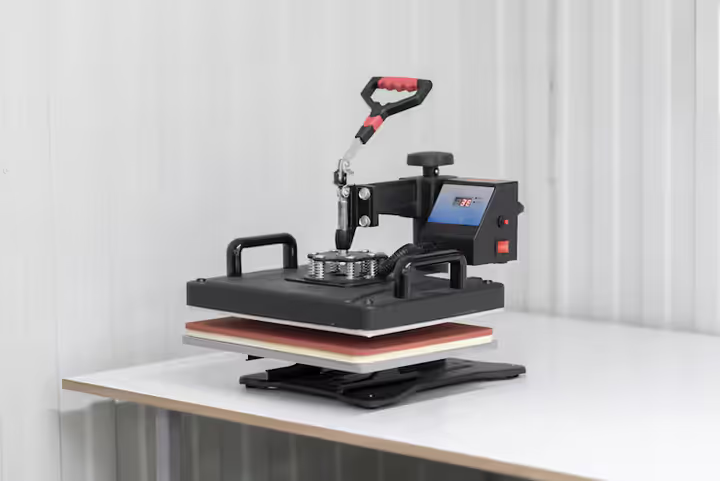
A heat press machine is a device designed to apply controlled heat and pressure for transferring designs, graphics, or coatings onto various materials. It exists to create durable, consistent transfers that cannot be achieved through simple manual methods. Heat press machines are commonly used for applying images, text, or functional layers onto fabrics, plastics, ceramics, and composite materials.
The development of heat press machines is closely tied to the growth of heat transfer technologies such as sublimation, vinyl transfer, and heat-applied coatings. Before these machines were introduced, transferring designs relied on less precise methods that often produced uneven results. Heat press machines provided a solution by combining regulated temperature, uniform pressure, and precise timing.
Modern heat press machines range from compact manual units to automated industrial systems. They are designed to support repeatable processes and consistent outcomes across a wide variety of materials and applications.
Importance: Why Heat Press Machines Matter in Manufacturing and Production
Heat press machines play an important role in industries where material bonding, surface decoration, or functional coating application is required. Their value lies in precision, repeatability, and control.
Who relies on heat press machines
-
Textile and garment production units
-
Printing and material finishing facilities
-
Promotional product manufacturers
-
Composite material processing operations
-
Packaging and labeling units
-
Educational and training workshops
Key challenges heat press machines help address
-
Achieving uniform heat distribution
-
Maintaining consistent pressure across surfaces
-
Ensuring durable adhesion of transferred materials
-
Reducing variation between production batches
-
Supporting repeatable processing conditions
By offering controlled processing environments, heat press machines help maintain quality and reduce material waste.
Recent Updates and Trends (2024–2025)
Heat press machine technology continues to evolve as materials and production requirements become more advanced.
Recent trends
-
Digital temperature control systems (2024): Improved accuracy and stability in heat settings.
-
Automated pressure adjustment (2024–2025): Systems adapted pressure dynamically based on material thickness.
-
Energy-efficient heating elements (2024): Reduced power consumption while maintaining performance.
-
Expanded material compatibility (2025): Machines adapted to newer substrates and transfer media.
-
Safety-focused design updates (2025): Enhanced insulation and protective features for operators.
These trends reflect increased emphasis on precision, efficiency, and operator safety.
Laws and Policies Affecting Heat Press Machine Use
Heat press machines are subject to safety, electrical, and workplace regulations to ensure proper operation.
Key regulatory considerations
-
Electrical safety standards: Machines must comply with voltage and insulation requirements.
-
Workplace safety regulations: Operator protection and safe machine operation are required.
-
Thermal safety guidelines: High-temperature equipment must include safeguards to prevent injury.
-
Material handling rules: Certain materials require controlled processing conditions.
-
Environmental guidelines: Energy usage and emissions may be regulated in industrial settings.
Adhering to these policies helps ensure safe and compliant machine operation.
Tools and Resources Used with Heat Press Machines
Effective operation of heat press machines relies on supporting tools and technical resources.
Operational and Control Tools
-
Digital temperature controllers
-
Pressure adjustment mechanisms
-
Timer and cycle control systems
-
Heat-resistant platens and pads
-
Alignment guides and fixtures
Maintenance and Optimization Resources
-
Calibration reference tools
-
Preventive maintenance checklists
-
Heating element inspection guides
-
Operator training manuals
-
Process documentation templates
These tools help maintain accuracy, safety, and consistent results.
Table: Common Types of Heat Press Machines
| Type | Description |
|---|---|
| Clamshell Heat Press | Opens and closes vertically |
| Swing-Away Heat Press | Upper platen swings aside for access |
| Draw Heat Press | Lower platen slides out for loading |
| Multi-Station Heat Press | Supports sequential processing |
| Industrial Heat Press | Designed for continuous or high-volume use |
Table: Typical Applications of Heat Press Machines
| Application Area | Purpose |
|---|---|
| Textile Processing | Applying designs or coatings to fabrics |
| Sublimation Transfer | Heat-based dye transfer to materials |
| Vinyl Application | Bonding heat-transfer vinyl |
| Composite Processing | Activating resin or adhesive layers |
| Labeling | Attaching heat-activated labels |
Heat Press Machine Workflow Overview
A typical heat press machine workflow includes:
-
Material Preparation
Substrate and transfer material are positioned correctly. -
Parameter Setting
Temperature, pressure, and time are configured. -
Pressing Cycle
Heat and pressure are applied for a defined duration. -
Cooling Phase
Material stabilizes after heat application. -
Transfer Completion
Carrier layers are removed as required. -
Inspection
Finished output is checked for consistency.
This workflow ensures controlled and repeatable heat transfer results.
FAQs
1. What is a heat press machine used for?
A heat press machine is used to apply controlled heat and pressure to bond materials or transfer designs.
2. What factors affect heat press results?
Temperature accuracy, pressure uniformity, pressing time, and material compatibility.
3. Are heat press machines suitable for different materials?
Yes. They are used on textiles, ceramics, metals, plastics, and composite surfaces.
4. How is pressure applied in a heat press machine?
Pressure is applied mechanically or pneumatically, depending on machine design.
5. Why is temperature control important in heat press machines?
Accurate temperature ensures proper bonding without damaging materials.
Conclusion
Heat press machines are essential tools for processes that require precise application of heat and pressure. Their ability to deliver consistent, repeatable results makes them valuable across textile processing, material finishing, and composite manufacturing environments. Recent advancements in digital controls, energy efficiency, and safety features continue to enhance machine performance. Supported by proper tools, regulatory compliance, and structured workflows, heat press machines remain a reliable solution for controlled heat transfer applications in modern production settings.