Battery Manufacturing Machines: Explanation of Equipment Used in Gigafactories
Battery manufacturing machines are specialized industrial systems used to produce rechargeable battery cells at scale. These machines form the backbone of modern energy storage production, especially for lithium-ion batteries used in electric vehicles, renewable energy storage, consumer electronics, and industrial equipment.
The topic exists because battery production requires extremely precise, repeatable, and controlled processes. Manual production is not viable at commercial scale due to safety risks, quality variation, and efficiency limits. Manufacturing machines automate each stage, from electrode preparation to final cell testing, ensuring consistency and reliability.
As global demand for electrification increases, battery manufacturing infrastructure has become a strategic industrial priority rather than just a factory operation.
Importance
Battery manufacturing machines matter today because energy storage demand is rising faster than most industrial sectors.
These machines directly affect multiple groups
- Electric vehicle manufacturers relying on stable cell supply
- Renewable energy projects using grid-scale storage
- Electronics manufacturers producing smartphones, laptops, and wearables
- Governments aiming to reduce fossil fuel dependence
They solve several critical problems at once. Automation improves production yield, reduces material waste, and enhances safety in handling reactive materials. Advanced machines also support higher energy density designs, which allow batteries to last longer while remaining compact.
From an economic perspective, efficient manufacturing equipment determines whether battery plants can scale without compromising quality or compliance.
Recent Updates
Over the past year, battery manufacturing technology has seen measurable changes driven by scale, regulation, and material innovation.
Key developments during 2025–2026
- Increased deployment of dry electrode coating machines, reducing solvent use and energy consumption
- Wider adoption of AI-based inspection systems for electrode defects and cell uniformity
- Expansion of gigafactory-level automation across Asia and Europe throughout 2025
- Integration of real-time production analytics into battery cell assembly lines by early 2026
In India, several advanced cell manufacturing plants announced equipment procurement milestones during mid-2025, reflecting a shift toward localized battery production.
These updates show a move away from labor-intensive setups toward fully automated, data-driven manufacturing environments.
Laws or Policies
Battery manufacturing machines are heavily influenced by regulatory frameworks because battery production involves chemicals, energy use, and waste management.
manufacturing equipment deployment is shaped
- Advanced Chemistry Cell (ACC) Production-Linked Incentive policy
- Environmental clearance norms under pollution control authorities
- Factory safety standards covering high-energy materials and solvents
Globally, equipment designs must align with international safety and environmental benchmarks, especially when exporting battery cells. Regulations increasingly emphasize traceability, emission reduction, and responsible material handling.
These policies encourage manufacturers to invest in newer, cleaner, and more efficient machines rather than legacy systems.
Battery Manufacturing Process and Machines
Battery manufacturing is divided into structured stages, each requiring specific equipment.
| Production Stage | Machines Involved | Purpose |
|---|---|---|
| Electrode mixing | Slurry mixers, dosing systems | Uniform material preparation |
| Coating | Electrode coating machines | Apply active material to foils |
| Drying | Continuous drying ovens | Remove moisture and solvents |
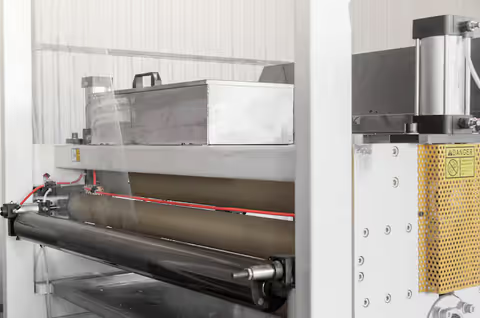
| Calendaring | Roller press machines | Control thickness and density |
| Cell assembly | Stacking or winding machines | Form battery cell structure |
| Electrolyte filling | Vacuum filling systems | Inject electrolyte safely |
| Formation | Charging formation racks | Activate electrochemical behavior |
| Testing | End-of-line testing systems | Quality and safety validation |
Each machine must operate within tight tolerances, as small deviations can affect battery performance or lifespan.
Tools and Resources
Several digital and technical tools support battery manufacturing machines throughout the production lifecycle.
Commonly used resources
- Manufacturing execution systems for battery plants
- Equipment performance monitoring dashboards
- Cell design simulation software
- Energy consumption tracking tools
- Industrial safety compliance checklists
Reference resources for learning and planning
- Government policy portals related to energy storage
- Technical standards published by international bodies
- Academic research databases on lithium-ion manufacturing
These tools help manufacturers align machine performance with quality, efficiency, and compliance requirements.
Industry Trends Table
| Trend | Impact on Manufacturing Machines |
|---|---|
| Higher energy density cells | Tighter process control |
| Solid-state battery research | New assembly equipment designs |
| Sustainability targets | Solvent-reduction machinery |
| Localized production | Modular machine layouts |
The table highlights how machine evolution follows battery chemistry and policy direction.
FAQs
What are battery manufacturing machines used for?
They are used to automate the production of battery cells by handling material mixing, coating, assembly, formation, and testing processes.
Which batteries rely most on these machines?
Lithium-ion batteries currently rely most on automated manufacturing machines due to their complexity and safety requirements.
Why is automation critical in battery manufacturing?
Automation ensures consistency, reduces defect rates, improves safety, and enables large-scale production without quality loss.
Are these machines standardized across manufacturers?
Core functions are similar, but machine configurations vary based on battery chemistry, plant capacity, and regulatory needs.
How do regulations affect machine design?
Regulations influence safety features, emissions control, waste handling, and data traceability built into the equipment.
Conclusion
Battery manufacturing machines play a foundational role in the global transition toward electrification and renewable energy. They enable safe, scalable, and efficient production of modern battery cells that power vehicles, devices, and energy systems.
As demand grows and regulations tighten, these machines continue to evolve through automation, digital monitoring, and sustainability-focused design. Understanding how they work, why they matter, and how they are regulated provides valuable insight into one of today’s most critical industrial ecosystems.
This topic will remain relevant as energy storage becomes central to economic growth and environmental goals worldwide.